
What Colors Can Bees See & Understanding How Bees See the World.
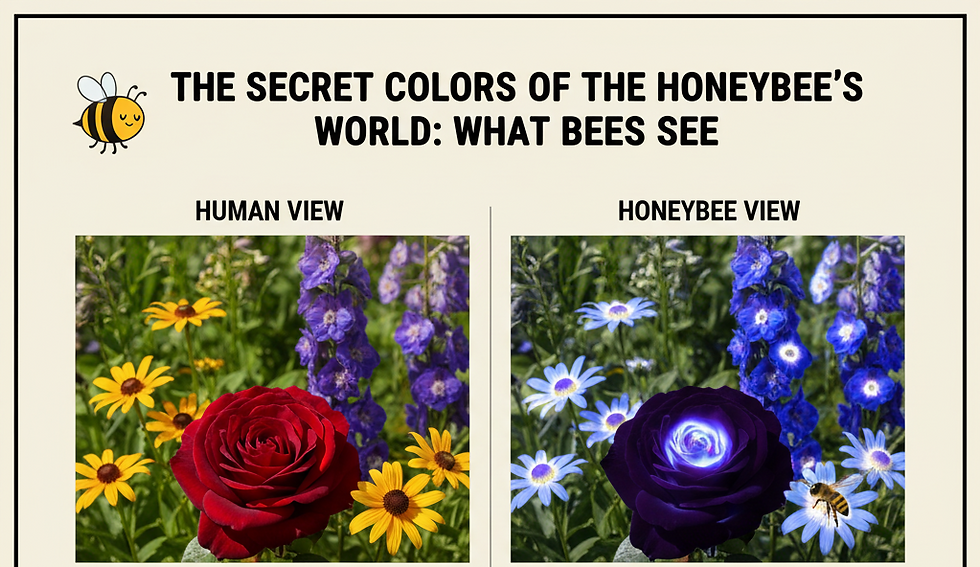
If you've ever wondered "can bees see red?" or "what colors can bees see?", you're not alone. Bee vision is one of nature's most fascinating adaptations, and understanding how bees see can help you create better gardens, appreciate pollination, and learn about the hidden world of color invisible to human eyes.
The short answer: No, bees cannot see red. But the complete story of bee eyesight is far more interesting than a simple yes or no.
Listen to This Article:
What Colors Do Bees See? The Bee Vision Spectrum Explained
While humans see colors from red to violet, bee color vision works completely differently. Here's what bees can see:
Colors Visible to Bees:
Ultraviolet (UV) – wavelengths from 300-400 nm (invisible to humans)
Blue – wavelengths from 400-500 nm (similar to human blue)
Green – wavelengths from 500-600 nm (similar to human green)
Colors Bees Cannot See:
Red – wavelengths above 600 nm appear as black or dark gray to bees
Orange-red spectrum – these longer wavelengths are outside bee vision range
This means the bee vision spectrum is shifted toward shorter wavelengths compared to humans. Bees essentially see the world in ultraviolet, blue, and green – a completely alien color palette from our own.
How Do Bees See? The Science of Bee Eyesight
To understand how bees see, we need to explore the remarkable structure of bee eyes.
Bee Compound Eyes Explained
Honeybees have two large compound eyes, each made up of approximately 5,500 tiny hexagonal lenses called ommatidia. This compound eye structure gives bees:
Nearly 280-degree field of vision (humans have about 180 degrees)
Exceptional motion detection – crucial for fast flight and predator avoidance
Rapid image processing – bees perceive motion 5-6 times faster than humans
Excellent pattern recognition for finding flowers

Bee Photoreceptors: Why Bees See Different Colors
Inside each ommatidium are photoreceptor cells that detect light. Humans have three types of color receptors (red, green, and blue). Bees also have three types, but they're tuned to:
UV receptors (peak sensitivity around 344 nm)
Blue receptors (peak sensitivity around 436 nm)
Green receptors (peak sensitivity around 544 nm)
This is why bees see UV light but not red – their photoreceptors simply aren't designed to detect longer red wavelengths.
Three Simple Eyes (Ocelli)
Beyond compound eyes, bees have three simple eyes called ocelli on top of their heads. These don't form images but help with:
Light level detection
Horizon orientation
Flight stabilization
Navigation
How Is Bee Vision Different from Human Vision?
The differences between bee vision vs human vision are striking:
Feature | Human Vision | Bee Vision |
Color Range | Red to Violet (400-700 nm) | UV to Green (300-650 nm) |
Can See Red? | Yes | No |
Can See UV? | No | Yes |
Eye Type | Simple lens eyes | Compound eyes (5,500+ lenses) |
Field of View | ~180 degrees | ~280 degrees |
Color Receptors | Red, Green, Blue | UV, Blue, Green |
Flicker Fusion | ~60 Hz | ~300 Hz (see faster motion) |
Best Colors | Full spectrum | Blue, purple, yellow with UV |

Why Can't Bees See Red? The Evolutionary Answer
Why do bees see UV light but not red? The answer lies in co-evolution with flowering plants.
The Bee-Flower Partnership
Flowers and bees evolved together over millions of years:
Flowers produce colors their pollinators can see – investing energy in pigments that attract bees
Bees evolved to see the colors flowers produce – creating a perfect partnership
UV patterns emerged as a "secret signal" between plants and pollinators
Red flowers evolved for different pollinators – primarily birds and butterflies who CAN see red
What Do Red Flowers Look Like to Bees?
When you ask "what do red flowers look like to bees?", the answer depends on UV reflection:
Pure red flowers (no UV reflection) appear dark gray or black – essentially invisible
Red flowers with UV reflection appear as bright UV patterns – highly visible and attractive
This is why some "red" flowers still attract bees – they're reflecting UV light we can't see
Do Bees See Ultraviolet Light? The Hidden World of Nectar Guides
Yes! Bees can see ultraviolet light, and this ability reveals a secret world of patterns invisible to humans.
What Are Nectar Guides?
Many flowers have evolved UV patterns called nectar guides – markings that:
Point directly to nectar and pollen sources
Act like "landing strips" for approaching bees
Look like bullseyes or radiating lines under UV light
Are completely invisible to human eyes
A simple yellow flower that looks uniform to us might display spectacular UV bullseye patterns to a bee, directing it exactly where to land and forage.
Examples of Flowers with UV Patterns:
Sunflowers – show UV-dark centers surrounded by UV-bright petals
Black-eyed Susans – have UV nectar guides pointing to their centers
Evening Primrose – display dramatic UV patterns
Many white flowers – reflect UV strongly and show detailed patterns

What Colors Do Bees See Best? Creating a Bee-Friendly Garden
Understanding what colors attract bees is crucial for gardeners and farmers.
Best Flower Colors for Bees:
1. Blue and Purple Flowers (Highly Attractive)
Lavender
Borage
Catmint
Salvia
Russian Sage
Aster
Blue Cornflower
These colors are within the bee's prime visual range and are consistently popular with bee species.
2. Yellow Flowers (Very Attractive)
Sunflowers
Goldenrod
Black-eyed Susans
Coreopsis
Rudbeckia
Dandelions
Yellow flowers often have strong UV patterns that bees find irresistible.
3. White Flowers (Attractive with UV Patterns)
White Clover
Alyssum
Apple Blossoms
Blackberry Flowers
Chamomile
White reflects UV light strongly, making these flowers highly visible to bees.
4. Violet Flowers (Attractive)
Violets
Crocus
Heliotrope
Monkshood
Violet is at the edge of both human and bee vision spectrums.

Flowers Bees May Ignore:
Red Flowers (Without UV Reflection)
Red Roses
Red Geraniums
Red Poppies
Red Dahlias
Red Tulips
These are better for attracting hummingbirds and butterflies. However, if you love red flowers, choose varieties that also reflect UV light – bees may still visit them!
How Bees See Flowers: The Foraging Process
How do bees see flowers when they're searching for food? The process is sophisticated:
Distance Detection – Bees spot flowers from up to 100 feet away using color and shape
Pattern Recognition – As they approach, UV patterns become visible
Landing Guidance – Nectar guides direct them to the exact spot
Color Memory – Bees remember which colors yielded the best rewards
Efficient Foraging – They return to the same flower colors repeatedly
Bee Pollination and Color
The relationship between bee pollination and color has shaped entire ecosystems:
Flowers evolved specific colors to match bee vision
Bees became more efficient pollinators by seeing UV patterns
This partnership increased plant reproduction success
About 1/3 of human food depends on bee pollination
Understanding bee vision helps farmers maximize crop yields
How Bee Eyes Work: Advanced Capabilities
Beyond color, how bee eyes work includes remarkable features:
Polarized Light Detection
Bees can see polarized light patterns in the sky, which helps them:
Navigate using the sun's position
Find their way home, even on cloudy days
Communicate direction through the waggle dance
Maintain orientation during long foraging trips
High Flicker Fusion Frequency
Bees perceive images at about 300 frames per second (humans see about 60 fps). This means:
Bees see the world in relative "slow motion"
They can react faster to threats
Fast-moving objects appear clear rather than blurred
This helps with precise flower landing and navigation
Pattern and Shape Recognition
Bee vision science has proven that bees can:
Distinguish between dozens of different patterns
Recognize human faces in experiments
Learn complex visual mazes
Remember flower shapes and locations for days

Best Plants for Bees: A Practical Guide
Creating bee garden colors that work means choosing plants bees can actually see:
Early Spring (When Bees Need Food Most):
Crocus (purple, yellow, white)
Snowdrops (white with UV patterns)
Hellebores (purple, white, green)
Pussy Willow (provides pollen)
Late Spring to Summer:
Lavender (purple)
Borage (blue)
Phacelia (purple-blue)
Sunflowers (yellow)
Cosmos (white, pink with UV)
Zinnia (avoid pure red varieties)
Late Summer to Fall:
Asters (purple, blue)
Goldenrod (yellow)
Sedum (pink-purple)
Coneflowers (purple, not red)
Herbs Bees Love:
Rosemary (blue)
Thyme (purple, white)
Oregano (purple)
Sage (purple, blue)
Mint (purple, white)
Attracting Bees to Your Garden
Now that you understand honeybee vision, here's how to attract bees:
Color Strategy:
Plant in color blocks – mass plantings are more visible than scattered flowers
Choose blue, purple, yellow, and white flowers primarily
Avoid pure red varieties unless you're also attracting butterflies
Provide blooms throughout the season – spring to fall
Other Important Factors:
Flower shape matters – bees prefer open or tubular flowers
Native plants are best adapted to local bee species
Avoid pesticides – especially neonicotinoids
Provide water sources – shallow dishes with landing stones
Leave some ground bare – many bees are ground-nesters

Last on Honeybees and the Color Red
To definitively answer "can honeybees see the color red?" – No, they cannot see red as we do. Red light wavelengths (above 600 nm) fall outside the visible spectrum for bees.
However, many "red" flowers DO attract bees because they:
Reflect ultraviolet light strongly
Have UV patterns visible to bees
May have blue or purple tones mixed with red pigments
So while bees can't see pure red, they can see UV patterns on flowers that APPEAR red to us.
Frequently Asked Questions About Bee Vision
What colors can't bees see?
Bees cannot see red and orange-red colors. These wavelengths appear as dark gray or black to them.
What colors do bees see best?
Bees see blue, purple, and yellow flowers best, especially when they have UV patterns.
Can bees see in the dark?
Bees have poor night vision. Most honeybees don't fly at night, though some species can navigate in very low light.
Do all bees have the same vision?
Most bee species (over 20,000 species worldwide) have similar UV-shifted color vision, though there are minor variations.
Why do bees see UV light?
UV vision evolved to help bees see nectar guides on flowers, improving foraging efficiency and pollination success.
How far can bees see?
Bees can detect flowers from about 30-100 feet away, depending on flower size, color, and contrast.
Can bees see better than humans?
Bees see UV light and detect motion faster than humans, but have lower visual resolution. Each species' vision is optimized for their needs.
What do bees use to see?
Bees use compound eyes (for color and images), simple eyes called ocelli (for light and orientation), and can detect polarized light.
Are bees color blind?
No! Bees have excellent color vision – it's just shifted to different wavelengths than human color vision.
Can bees recognize faces?
Yes! Studies show bees can be trained to recognize human faces, despite having much smaller brains than humans.

In the End: Seeing the World Through Bee Eyes
Understanding what colors bees see transforms how we think about gardens, agriculture, and nature.
The inability of bees to see red, combined with their spectacular UV vision, has shaped millions of years of evolution between flowers and their most important pollinators.
Next time you see a bee visiting flowers in your garden, remember:
That bee sees UV patterns you can't imagine
Red flowers may be nearly invisible to it
Blue and purple blooms are like neon signs
Every flower visit is part of an ancient partnership
By choosing the right flowers that attract bees and understanding how bee eyes work, you're not just creating a beautiful garden – you're supporting the pollinators that keep our ecosystems thriving and put food on our tables.
The world of bee color vision reminds us that reality isn't absolute – it's perceived differently by every creature. And in the case of bees, that different perception has made all the difference for life on Earth.
Want to create a bee-friendly space? Start with blue, purple, yellow, and white flowers that bloom throughout the season. Check with your garden center as many flowers we think the bees will like, they don't. They garden centers know what the bees will actually be attracted to.
Your local bees will thank you – even if they can't see red!
Betsy & Pete
🐝Las Vegas’s All-Natural Live Bee Removal Team
About Us: The Authors

We’re Betsy and Pete - Beekeepers on a Mission in Las Vegas
We’re not just in the bee business, we’re in the bee-saving business. Trained by a master beekeeper and backed by hundreds of successful removals, we are dedicated to rescuing and relocating honey bees with care and precision.
Every swarm we save and every hive we manage reflects our deep love for the bees.
At our Joshua Tree Preserve in Arizona, we care for dozens of thriving hives. Some wild, some honey-bearing, and all are part of our commitment to ethical, sustainable beekeeping.
Why Vegas Bees? Because We Never Stop Learning or Caring
Beekeeping is always evolving, and so are we. We stay on the cutting edge by continuing our education, connecting with fellow beekeepers, and refining our beekeeping practices and techniques to ensure the best outcomes for both bees and people.
Whether it’s advanced bee removal strategies or the latest natural methods, we’re always one step ahead.
We’re also proud to support the beekeeping community with high-quality beekeeping supplies for everyone. If you’re ready to suit up and start your journey, we’ve got what you need. Wanna become a beekeeper? Read our Beekeeping for Beginners Guide.


