
Why Bees Are at Your Sprinklers and Drip Lines.

Are Bees Gathering Around Your Outdoor Irrigation? Here’s What’s Going On.
If you step outside and see bees hovering around your sprinkler heads or crawling along drip lines, it definitely can feel strange and worrisome.
We get these calls all the time in Las Vegas, especially in peak summer.
The reality is simple. This is one of the most common and least understood bee behaviors in the desert.
The good news is that it’s usually not an emergency. The better news is that once you understand it, you can control it.
Why Bees Are Attracted to Your Irrigation
Honey bees are not there by accident. They are there because your yard is solving a critical survival problem.
In extreme heat, a colony’s demand for water skyrockets. A strong hive can use a quart or more per day, sometimes much more during Las Vegas summers.
That water is essential to how the colony functions.
What Do Bees Actually Use Water for?
Cooling the hive
Bees spread water inside the hive and fan it with their wings to create evaporative cooling. This is how they prevent the colony from overheating in 110°F conditions.
Feeding developing brood
Larvae rely on diluted food that requires a steady water supply. No water means no healthy next generation.
Rehydrating stored honey
Crystallized honey must be dissolved before bees can consume it.
Once a water source proves reliable, bees lock onto it. They return daily and recruit more foragers. That is why a few bees can quickly turn into dozens.
Why Las Vegas Yards Attract So Many Bees
In most regions, bees can pull from ponds, creeks, or puddles. In Las Vegas, those options don't exist.
Your irrigation system often becomes the most dependable water source in the entire neighborhood.
What Are the Biggest Attractors?
Drip emitters
Slow, consistent output makes them incredibly attractive. It mimics a natural spring.
Moist soil
Wet ground gives bees a safe place to land and drink without drowning.
Leaky sprinkler heads
Even a small, constant leak is enough to draw steady bee traffic.
Other hidden sources
Plant saucers, birdbaths, and A/C condensate drain lines all act the same way.
Are Bees at Your Sprinklers Dangerous?
Most of the time, no. Water-foraging bees are focused on their job. They are not out looking for trouble. That said, I never downplay risk in Southern Nevada.
Risk increases when:
The bees are Africanized
A large percentage of feral colonies in Clark County carry Africanized genetics, which makes them more defensive.
The hive is close by
If a colony is inside a wall, tree, or structure on your property, behavior can shift quickly near that location.
Numbers are climbing fast
A handful of bees is normal. Large clusters or sudden spikes deserve attention.

What Not to Do
This is where most people unknowingly make things worse.
Do not spray pesticides
You will not solve the problem. You will just kill a few foragers while the colony sends more.
Do not try to drown them
This agitates bees and increases the chance of defensive behavior.
Do not shut off water sources expecting them to disappear instantly
Bees return to known locations for days, even after the water is gone.
Do not ignore a sudden surge in activity
That can signal a nearby colony establishing itself.
What Actually Works
If you want bees away from your irrigation, you need to outcompete it.
The most effective strategy:
Create a better water source
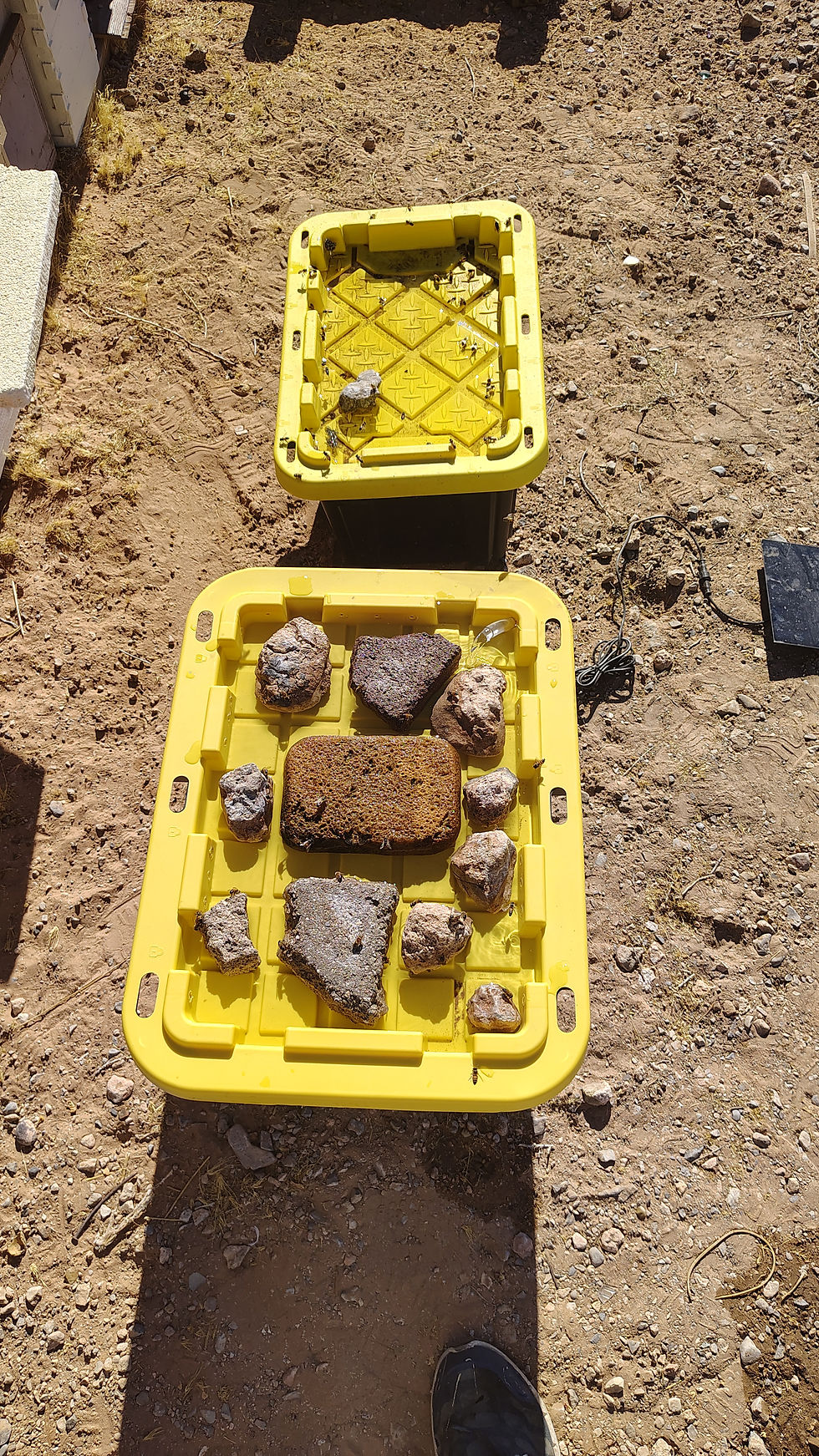
Set up a shallow dish or birdbath with rocks or corks for landing. Place it away from high-traffic areas and keep it consistently filled.
Once bees adopt it, they will redirect their entire foraging pattern.
Use lightly chlorinated water
Bees are drawn to minerals. A small amount of pool water can make your decoy source more attractive.
Fix leaks
If a drip emitter is constantly wet, bees will keep coming back. Every time.
Adjust irrigation timing
Run systems early morning or late evening to reduce overlap with peak bee activity.

When It’s Time to Call a Professional
I tell people this all the time. Bees at water alone usually do not require removal.
But there are clear situations where you should act.
Call if:
You are seeing large, consistent numbers in one location
A swarm recently landed on your property
You suspect bees are inside a wall, tree, or structure
The bees are acting aggressive
You have kids, pets, or anyone with sting sensitivity using the space
At Vegas Bees, we inspect the situation, determine whether a colony is present, and give you a clear plan. Sometimes that means removal. Sometimes it just means redirecting the bees properly.
How to Prevent This Long-Term
If you want to stop dealing with this every summer, consistency matters.
Fix leaks immediately
Eliminate standing water
Maintain a dedicated bee water station away from activity zones
Pay attention to year-over-year increases in bee traffic
Small changes can make a big difference.

Quick Answers to Common Questions
Why did bees suddenly show up at my drip system?
They found a reliable water source and reported it back to the hive.
Are they the same bees every day?
Yes, typically from the same colony returning repeatedly.
How far away is the hive?
Anywhere from a few hundred feet to a couple of miles.
Will they sting me while I’m outside?
Unlikely if left alone, but avoid fast movement or swatting.
Why are they still coming after I turned off the water?
Bees rely on memory. It takes time for them to abandon a known source.
Can I redirect them?
Yes. A better water source is the most effective solution.
Does this mean I have a hive?
Not necessarily, but rising numbers can be a clue.
The Bottom Line
Most of the time, bees at your sprinklers are just doing what they have to do to survive the desert.
But if activity is increasing, behavior feels off, or you want certainty, I take a look and give you a straight answer. That is what we do at Vegas Bees.
Betsy & Pete
🐝Las Vegas’s All-Natural Live Bee Removal Team
About Us: The Authors

We’re Betsy Lewis and Pete Rizzo - Beekeepers on a Mission in Las Vegas
We’re not just in the bee business, we’re in the bee-saving business. Trained by a master beekeeper and backed by hundreds of successful removals, we are dedicated to rescuing and relocating honey bees with care and precision.
Every swarm we save and every hive we manage reflects our deep love for the bees.
At our Joshua Tree Preserve in Arizona, we care for dozens of thriving hives. Some wild, some honey-bearing, and all are part of our commitment to ethical, sustainable beekeeping.
Why Vegas Bees? Because We Never Stop Learning or Caring
Beekeeping is always evolving, and so are we. We stay on the cutting edge by continuing our education, connecting with fellow beekeepers, and refining our beekeeping practices and techniques to ensure the best outcomes for both bees and people.
Whether it’s advanced bee removal strategies or the latest natural methods, we’re always one step ahead.
We’re also proud to support the beekeeping community with high-quality beekeeping supplies for everyone. If you’re ready to suit up and start your journey, we’ve got what you need.


