
How Las Vegas Homes Quietly Host Bees Without Anyone Noticing.
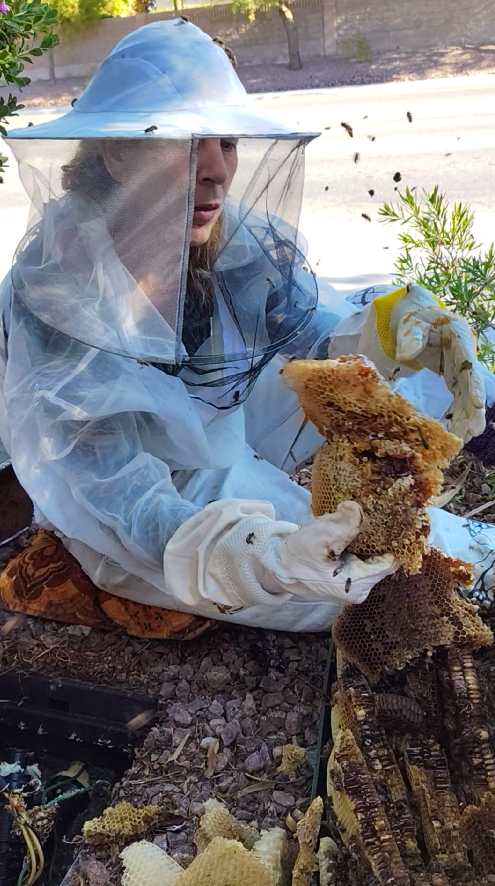
In our line of work, we see something homeowners rarely expect. People call us thinking they've just developed a bee problem, but when we open things up, the truth is almost always the same: that colony didn't just arrive last week.
Homeowners are shocked to find out that It's been there, quietly building and growing, sometimes for months, sometimes for years. By the time we get there, the home has already been functioning as a hidden hive, and unlike most tenants, this one never once considered paying rent.
How Homes in Las Vegas Become Unintentional Beehives
Las Vegas homes are almost perfectly designed for bees, even though they were never meant to be.
Stucco exteriors develop tiny expansion cracks, rooflines have shaded voids with easy entry points, block walls hold stable internal temperatures, and irrigation and utility boxes stay protected year-round.
To a homeowner, these are just normal parts of a house. To bees, they're prime real estate. All it takes is one small opening, once a swarm finds it, they move in fast and start building comb deep inside areas no one ever looks.

Why You Don't Notice The Bees
Here's where it gets interesting. Most active hives in Las Vegas don't announce themselves with big, obvious swarms flying everywhere.
Early on, the activity is minimal and easy to miss. We regularly hear things like "we only saw a few bees here and there" or "they weren't bothering anyone, so it didn't seem like a big deal."
This is because a developing colony is efficient and low-profile at first, foragers come and go in small numbers, the entrance might be tucked under an eave or behind a fixture, and from the outside it all looks harmless.
It is, in effect, a very successful startup that has chosen not to advertise. Meanwhile, inside the structure, the hive is expanding rapidly.
What's Actually Happening Inside Your Walls
Once bees establish themselves, they don't stay small for long. Inside the wall or ceiling cavity, they're building layers of wax comb, raising brood continuously, and storing large amounts of honey.
In the desert heat of the Mojave, this process accelerates. Over time, you end up with heavy comb structures attached to framing, honey buildup that can soften and start to drip, and heat stress that can destabilize the hive internally.
That stored honey doesn't just sit there forever, it attracts ants, roaches, and other pests, seeps into insulation, stains drywall, and can even create odor problems that won't go away until everything is fully removed.
It turns out an abandoned honey reserve is not a passive asset, it is a liability that appreciates in unpleasantness over time.

The Moment It Stops Being "Quiet"
Most homeowners never notice the hive during that quiet phase. They notice it when something changes. Usually a sudden increase in bee activity, bees showing up inside the home, a visible swarm forming nearby, or defensive behavior around a specific area of the house.
What feels like a sudden problem is almost always the result of a colony that has outgrown its space or become stressed. By then, the situation is no longer small.
Why This Matters for Bee Removal
This is where experience really matters, because a hidden hive is about removing bees and addressing everything they've built behind the surface.
If the comb and honey are left behind, bees often return to the same location, pests move in quickly, and structural damage continues to develop.
That means we need to locate the entire colony, not just the entrance, performing a proper cut-out when necessary, removing the comb, brood, and honey, and then sealing the entry points to prevent future re-entry.
Anything less is a temporary fix, the insect equivalent of asking politely and hoping for the best.

If You're Seeing Signs, It's Worth Checking
When people reach out to us at Vegas Bees, it's usually after something stops adding up. They've seen a few bees for a while, and then suddenly it's more than a few.
We step in, assess the structure, and figure out exactly what's going on inside, not just what's visible from the outside. Catching a colony early can mean a simpler removal, less structural impact, and a lower overall cost.
Waiting usually means the opposite. Bees do not use this time to reconsider their life choices. If you're noticing consistent bee activity around your home, even if it seems minor, it's worth taking seriously. We handle these situations every day and know exactly what to look for.
If something feels off, we're here to take a closer look and give you a clear answer.
Betsy & Pete
🐝Las Vegas’s All-Natural Live Bee Removal Team
About Us: The Authors

We’re Betsy Lewis and Pete Rizzo - Beekeepers on a Mission in Las Vegas
We’re not just in the bee business, we’re in the bee-saving business.
Trained by a master beekeeper and backed by hundreds of successful removals, we are dedicated to rescuing and relocating honey bees with care and precision.
Every swarm we save and every hive we manage reflects our deep love for the bees.
Why Vegas Bees? Because We Never Stop Learning or Caring
Beekeeping is always evolving, and so are we. We stay on the cutting edge by continuing our education, connecting with fellow beekeepers, and refining our beekeeping practices and techniques to ensure the best outcomes for both bees and people.
Whether it’s advanced bee removal strategies or the latest natural methods, we’re always one step ahead.
We’re also proud to support the beekeeping community with high-quality beekeeping supplies for everyone. If you’re ready to suit up and start your journey, we’ve got what you need.
Want to become a beekeeper? Read our Beekeeping for Beginners Guide.


