
Stop Mowing Your Lawn. Give Back to the Bees.
Updated: Apr 30
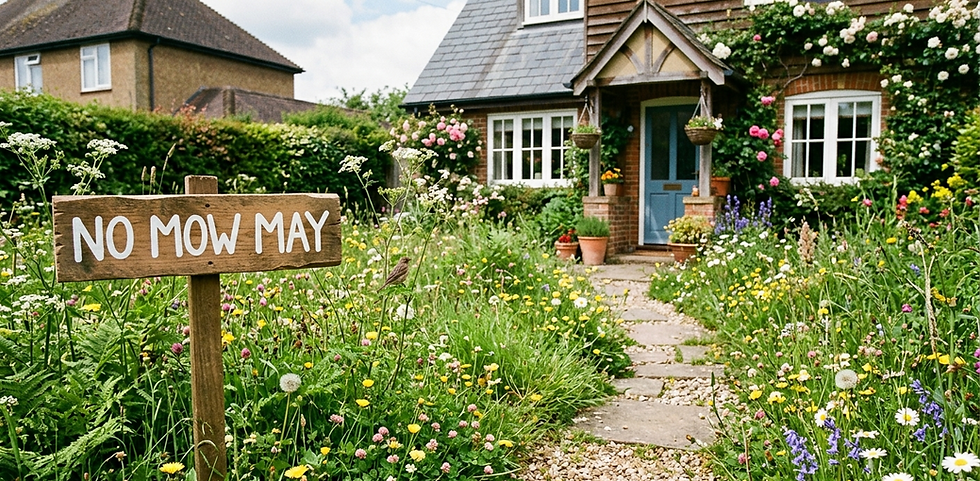
For decades, the "perfect" American lawn has been defined by one thing: short, uniform, bright green grass. But that suburban dream is becoming a nightmare for the planet’s most important workers.
If you’ve been looking for an excuse to skip the yard work this weekend, science just gave you a great one. It turns out that a perfectly manicured lawn is essentially a "food desert" for bees.
The "Green Desert" Problem
To a honeybee or a wild bumblebee, a freshly mowed lawn looks like a barren
wasteland. While we see a neat carpet of green, bees see a lack of habitat and, more importantly, a lack of food.
When we mow our lawns every week, we decapitate the very flowers that bees rely on for survival. Dandelions, clover, and violets may be often dismissed as "weeds", are actually life-saving "superfoods" for pollinators, especially in the early spring when other flowers haven't yet bloomed.

It’s Not Just About Food
It isn’t just about the nectar. Did you know that nearly 70% of all bee species nest underground?
When we use heavy mowers and maintain tightly packed turf, we destroy the soft, undisturbed soil these solitary bees need to raise their young.
By letting the grass grow just a few inches longer, you create a canopy that regulates soil temperature and moisture, providing a safe haven for the next generation of pollinators.
The "Lazy Lawn" Revolution
Researchers at the U.S. Forest Service recently conducted a study with a surprising result: homeowners who mowed their lawns every two weeks instead of every week saw a 300% increase in the variety of bee species in their yards.
This movement, often called "No Mow May" or "Lazy Lawns," isn't about letting your yard turn into a jungle. It’s about "strategic neglect."

How to Help Without Annoying the Neighbors
You don't have to let your front yard become an eyesore to make a difference. Here is how to strike a balance:
The "Mow High" Rule
Set your mower blades to at least 3 or 4 inches. This allows low-growing flowers like clover to survive and bloom.
The "Buffer Zone"
Keep the edges of your lawn neat, but leave a "wild patch" in the back or along a fence line where the grass and wildflowers can grow tall.
Embrace the Clover
Instead of using herbicides to kill clover, embrace it. It stays green even in droughts and provides high-quality protein for bees.

The Bottom Line
The next time you feel the urge to fire up the mower, remember: a little bit of mess goes a long way. By doing less work, you’re actually doing more for the environment.
The bees get a feast, the soil stays healthy, and you get your Saturday morning back. It’s a rare win-win for both humans and nature.
Betsy & Pete
🐝Las Vegas’s All-Natural Live Bee Removal Team
About Us: The Authors

We’re Betsy Lewis and Pete Rizzo - Beekeepers on a Mission in Las Vegas
We’re not just in the bee business, we’re in the bee-saving business. Trained by a master beekeeper and backed by hundreds of successful removals, we are dedicated to rescuing and relocating honey bees with care and precision.
Every swarm we save and every hive we manage reflects our deep love for the bees.
At our Joshua Tree Preserve in Arizona, we care for dozens of thriving hives. Some wild, some honey-bearing, and all are part of our commitment to ethical, sustainable beekeeping.
Why Vegas Bees? Because We Never Stop Learning or Caring
Beekeeping is always evolving, and so are we. We stay on the cutting edge by continuing our education, connecting with fellow beekeepers, and refining our beekeeping practices and techniques to ensure the best outcomes for both bees and people.
Whether it’s advanced bee removal strategies or the latest natural methods, we’re always one step ahead.
We’re also proud to support the beekeeping community with high-quality beekeeping supplies for everyone. If you’re ready to suit up and start your journey, we’ve got what you need.


