
Can Bees Chew Through Drywall and Sheetrock?
Updated: Jun 11

Yes, bees can chew through drywall, especially if the colony becomes trapped inside the wall or the hive grows large enough to weaken the structure.
In Las Vegas heat, melting comb, heavy honey stores, and trapped bees searching for an exit can eventually cause bees to emerge through walls, ceilings, vents, and light fixtures.
Do Bees Chew Through Drywall?
A common myth is that honey bees do not chew through drywall because they do not "eat" it like termites or carpenter ants. Its not a meal, they will chew through drywall to save themselves.
While it is true that honey bees do not eat gypsum or paper, they absolutely can and will chew through drywall using their mandibles.
There are two primary scenarios where honey bees chew through drywall:
They Are Trapped.
If a homeowner tries to solve a bee problem by sealing the exterior entry hole on the outside of the house, the trapped bees will frantically search for another exit.
They will aggressively chew through the interior paper backing and gypsum core of your drywall, often breaking into the living space within a few days.
Space Expansion.
As a colony grows, worker bees will sometimes scrape and chew away at the interior drywall surface to clear space for more wax comb or to clear debris out of their nesting area.
Scratching Sound in Wall: Bees or Wasps?
When homeowners search for answers about wall damage, they are often dealing with a case of mistaken identity. It is crucial to distinguish between honey bees and wasps (such as yellow jackets or hornets), as their nesting and chewing habits are very different.
Honey Bees (Apis mellifera)
The Sound.
Typically makes a constant, low, rhythmic buzzing or humming sound.
The Damage.
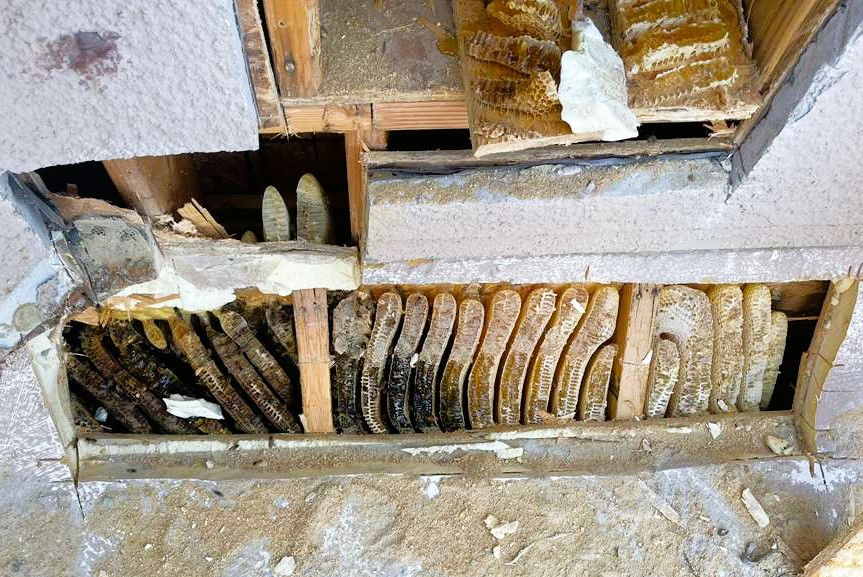
Honey bees prefer to build their wax combs attached to studs and the inside of the drywall. The damage they cause is mostly due to moisture, heat, and weight.
Yellow Jackets and Hornets
The Sound.
Often produces a distinct, rhythmic scratching sound in the wall as they scrape away at materials.
The Damage.
These insects are notorious for yellow jackets chewing through ceiling drywall. They build paper nests by mixing chewed wood and paper fibers with saliva.
To expand their nests, they will actively chew away at your ceiling or wall drywall until it is paper-thin. In a matter of days, a nest of yellow jackets can break completely through a ceiling, flooding a room with aggressive, stinging pests.

How a Honey Bee Nest Inside Wall Cavities Causes Damage
Beyond active chewing, a growing honey bee colony creates a physical environment that naturally degrades drywall over time.
Extreme Heat Softens the Wall
A healthy honey bee colony generates a surprising amount of heat. Bees actively regulate their brood nest temperature to about 93°F to 95°F (34°C to 35°C).
In hot climates, particularly in regions like Las Vegas, summer temperatures inside a closed wall cavity can easily climb past 130°F.
Beeswax begins to soften around 95°F and melts completely between 143°F and 147°F. Under these extreme conditions, the wax softens, sags, and can experience a catastrophic collapse, releasing liquid honey directly onto the drywall.

Massive Weight Strain
Most homeowners underestimate how heavy a bee hive can become inside a wall. A mature colony can store 50 to 100+ pounds of honey and wax.
Drywall was never structurally engineered to support hanging weight from behind. Over time, the heavy comb pulls on the drywall's paper backing, leading to structural sagging, bowing, or complete drywall collapse.
Moisture and Rot
Honey is highly hygroscopic, meaning it absorbs moisture from the air. This moisture, combined with the humidity generated by thousands of breathing bees, saturates the drywall from the inside. This leads to:
Soft, mushy spots in the wall
Bubbling or peeling paint
Dark, oily stains on the ceiling or walls
Mold and mildew growth

How Long Does It Take for Bees to Break Through Drywall?
If a swarm has just entered your wall, you might wonder how much time you have to react.
If the exterior exit is sealed (Trapped Bees)
Trapped bees may begin chewing through drywall surprisingly quickly, sometimes within a few days.
If the exit is open (Untreated Active Colony)
It can take several months to a year for the structural weight, moisture, and heat to weaken the drywall enough to cause a spontaneous collapse.
If dealing with Yellow Jackets:
These pests can intentionally chew through ceiling drywall in a few days to a couple of weeks, depending on the size of the colony.

Betsy & Pete
🐝Las Vegas’s All-Natural Live Bee Removal Team
Shout out to our friend Dave from LVBEES who takes some great pictures, which you can see some in this article.
About Us: The Authors

We’re Betsy Lewis and Pete Rizzo - Beekeepers on a Mission in Las Vegas
We’re not just in the bee business, we’re in the bee-saving business. Trained by a master beekeeper and backed by hundreds of successful removals, we are dedicated to rescuing and relocating honey bees with care and precision.
Every swarm we save and every hive we manage reflects our deep love for the bees.
At our Joshua Tree Preserve in Arizona, we care for dozens of thriving hives. Some wild, some honey-bearing, and all are part of our commitment to ethical, sustainable beekeeping.
Why Vegas Bees? Because We Never Stop Learning or Caring
Beekeeping is always evolving, and so are we. We stay on the cutting edge by continuing our education, connecting with fellow beekeepers, and refining our beekeeping practices and techniques to ensure the best outcomes for both bees and people.
Whether it’s advanced bee removal strategies or the latest natural methods, we’re always one step ahead.
We’re also proud to support the beekeeping community with high-quality beekeeping supplies for everyone. If you’re ready to suit up and start your journey, we’ve got what you need. Wanna become a beekeeper? Read our Beekeeping for Beginners Guide.


