
Our Guide to Varroa Mites and Protecting Your Hives.
Updated: Jan 25
If you keep bees, you are also, unfortunately, a mite manager.
The Varroa destructor mite is widely considered the single greatest threat to honey bee health globally.
For us in warmer climates like Las Vegas, where brood rearing can happen nearly year-round, understanding this enemy is critical to your colony's survival.
Our guide covers everything you need to know about the Varroa mite, from its vampire-like biology to the most effective ways to detect and treat it.
Listen to the Article:
A Note on Imagery: We have intentionally chosen not to show graphic photos of the damage mites cause to bees. The effects can be heartbreaking and graphic, and we prefer to keep this guide focused on solutions rather than the sad reality of a collapsed hive.
Know the Enemy
What is Varroa destructor?
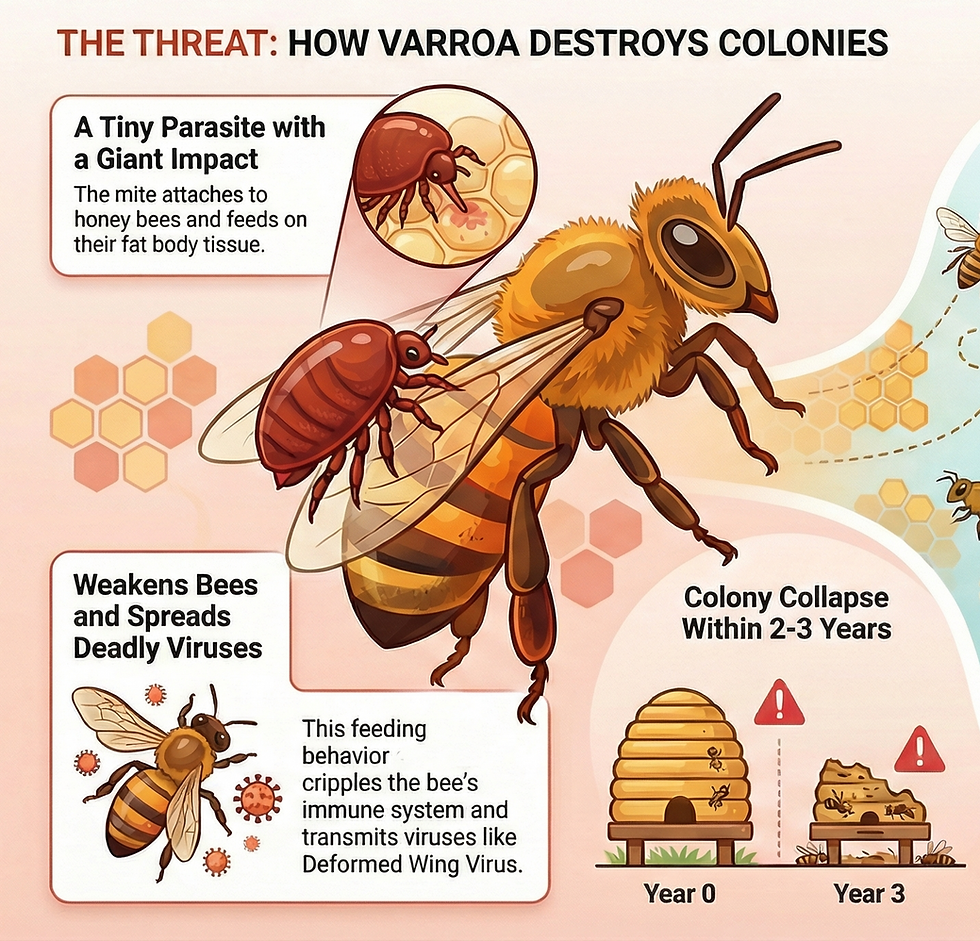
The Varroa mite is a tiny, reddish-brown external parasite (ectoparasite). While they look like small specks to the naked eye (about the size of a pinhead), relative to a bee, they are massive - roughly the size of an average dinner plate attached to a human.
Originally, these mites hosted on the Asian honey bee (Apis cerana), which evolved natural defenses against them. However, when the mites shifted to the Western honey bee (Apis mellifera) - the kind we keep - our bees had no natural defenses.
This lack of resistance is why untreated infestations are almost always fatal.

The Two Stages of the Life Cycle
To effectively manage mites, you must understand their two-phase life cycle. The entire cycle occurs within the hive:
The Phoretic Phase (Hitchhiking):
Adult female mites attach themselves to adult bees.
They feed on the bee’s "fat body" (an organ similar to a liver) and hemolymph (blood). This weakens the bee, shortening its lifespan and impairing its ability to navigate.
Mites spread from hive to hive during this phase via drifting bees, robbing, or swarming.
The Reproductive Phase (The Brood):
This is where the population explodes. A female mite slips into a brood cell just before it is capped.
She hides in the brood food at the bottom of the cell to avoid detection by nurse bees.
Once the cell is capped, she begins laying eggs. The first is male; the rest are female. The siblings mate within the sealed cell.
The Drone Trap: Mites prefer drone brood (male bees) by a factor of 10-12 because drones take longer to emerge, giving the mites more time to reproduce. A single mite entering a worker cell might produce 1.6 offspring, but in a drone cell, she can produce 2.6.
Why Us Las Vegas Beekeepers Need to Worry: In temperate climates, cold winters stop brood rearing, which naturally pauses mite reproduction. In warmer climates like ours, if the queen lays year-round, the mites breed year-round. Populations can increase 800-fold in a single year without a brood break.

The Damage Caused
It’s Not Just the Bite - It’s the Viruses
The physical feeding of the mite is damaging, but the viruses they transmit are the real killers. Varroa mites act as a "dirty needle," injecting viruses directly into the bees' blood.
Deformed Wing Virus (DWV): The most common sign of a severe infestation. Bees emerge with shriveled, useless wings and bloated abdomens.
Parasitic Mite Syndrome (PMS): As the colony collapses, you will see a "shotgun" brood pattern (spotty brood), chewed-down larvae, and uncapped cells. The colony eventually dwindles and dies, often leaving behind plenty of honey but no bees.
Mite Detection & Monitoring
You cannot rely on seeing mites on the backs of bees. By the time you see them walking on adult bees, your infestation is likely already critical. You must perform regular checks.
The Alcohol Wash (Most Accurate)
How it works: You collect a sample of roughly 300 bees (½ cup) from a brood frame and wash them in alcohol. This kills the sample but dislodges roughly 95% of the mites for an accurate count.
The Threshold: If you find more than 3 mites per 100 bees (roughly 9 mites in a ½ cup sample), immediate treatment is usually required.
The Sugar Shake (Non-Lethal)
How it works: Similar to the alcohol wash, but uses powdered sugar to dislodge mites. The bees are released alive (though stressed).
Pros/Cons: It is less accurate than an alcohol wash, especially in humid conditions where sugar clumps, but it saves the bees.
Sticky Boards
How it works: A sticky sheet is placed under a screened bottom board for 3 days to catch falling mites.
Usage: This doesn't give you a precise infestation percentage but is great for trending (is the population going up or down?) and checking if a treatment worked.

Integrated Pest Management (IPM)
The best approach minimizes chemical use by combining mechanical, genetic, and chemical controls. This is called Integrated Pest Management.
Mechanical Controls (Non-Chemical)
Screened Bottom Boards: These allow mites that fall off bees to drop out of the hive rather than crawling back up. This alone can reduce mite populations by about 10-15%.
Drone Brood Removal: Since mites prefer drone brood, you can insert a frame of drone foundation. Once the bees cap it (and it is full of mites), you remove the frame and freeze it to kill the mites.
Brood Breaks: Caging the queen or splitting the hive creates a period with no capped brood. This forces all mites into the "phoretic" stage (on adult bees), stopping reproduction and making chemical treatments much more effective.
Genetic Controls
Hygienic Stock: Some bees (like VSH or Russian lines) are bred to detect mites in capped brood. They will uncap and remove the infested pupae, interrupting the mite's reproductive cycle.
Varroa Treatment Options
When monitoring shows your mite levels are too high, you must treat. Rotating treatments is vital to prevent mites from building resistance.
"Soft" Chemicals (Organic Acids & Essential Oils)
These are naturally occurring compounds. They are generally safer for wax but can be temperature-sensitive - a big factor in Las Vegas.
Formic Acid: The only treatment that penetrates the cappings to kill mites inside the brood. Warning: Can cause queen loss in high heat.
Oxalic Acid: Highly effective on adult mites but does not kill mites under the cappings. Best used during a brood break or in winter.
Thymol (Essential Oil): Effective but requires specific temperature ranges to evaporate properly without driving the bees out of the hive.
"Hard" Chemicals (Synthetic Miticides)
Amitraz (Apivar): Highly effective plastic strips. However, resistance is beginning to appear in some parts of the world.
Fluvalinate & Coumaphos: Older chemicals that are largely ineffective now due to widespread mite resistance. They also leave lasting residues in the honeycomb.
Varroa Mites FAQ
Where did varroa mites come from?
Varroa mites originated in Asia, specifically from the Asian honey bee (Apis cerana), where they are a natural parasite and do not cause significant harm. However, when they jumped to the European honey bee (Apis mellifera), they became a devastating pest.
Can humans get varroa mites?
No, humans cannot get varroa mites. Varroa mites are host-specific to honey bees and cannot survive or reproduce on humans or other animals.
What eats varroa mites?
While some predators like pseudoscorpions and certain beetle larvae have been observed consuming varroa mites, they are not effective biological control agents in managing mite populations in a hive. Some birds might also eat them if exposed.
Can varroa mites survive without bees?
Varroa mites can only survive for a very short period (a few days at most) without a bee host. They require bees for food (hemolymph) and reproduction.
What kills Varroa mites naturally?
There are no truly effective "natural predators" that significantly control varroa mite populations in a hive. However, some beekeepers use naturally derived substances like oxalic acid, formic acid, and essential oils (e.g., thymol) as treatments, which are considered more "natural" than synthetic chemical miticides.
What countries don't have varroa mites?
Currently, Australia is the largest landmass generally considered free of Varroa destructor, although there have been recent incursions that are being actively managed. Some isolated islands and remote regions may also be free of them.
Can honey bees survive Varroa mites?
Without intervention, European honey bee colonies generally cannot survive varroa mite infestations for long. Mites weaken bees, spread viruses, and ultimately lead to colony collapse. However, some bee populations are developing resistance or tolerance over time.
How to tell if bees have Varroa mites?
Several methods can be used:
Sticky Board/Screened Bottom Board: A sticky board placed under a screened bottom board will catch mites that fall off bees, allowing you to count them.
Powdered Sugar Roll: Bees are gently shaken with powdered sugar in a jar. The sugar causes mites to detach and fall through a screen.
Alcohol Wash: Bees are washed in alcohol, which dislodges and kills the mites, allowing for accurate counting.
Visual Inspection: While difficult, you might occasionally spot mites on adult bees, especially drones, or on bee pupae when inspecting brood.
What is the lifespan of a varroa mite?
The lifespan of a varroa mite varies depending on the season and the presence of brood. In the presence of brood, a female mite's adult lifespan is typically 2-3 months. Without brood (e.g., in winter), they can live longer, up to 5-8 months, by feeding on adult bees.
Do native bees get Varroa mites?
Generally, native bees in North America and Europe are not affected by Varroa destructor. This mite is highly host-specific to Apis species. However, other types of mites can parasitize native bees.
Can Varroa mites live without bees?
No, as mentioned earlier, varroa mites cannot live independently for long without a bee host. They rely entirely on bees for their food source and reproductive cycle.
How do Varroa mites survive winter?
During winter, when brood rearing significantly decreases or stops, varroa mites transition to a phoretic phase, attaching themselves to adult honey bees. They feed on the bees' hemolymph, weakening them. This allows them to survive until spring when brood rearing resumes and they can re-enter the reproductive cycle.
The Vegas Bees Promise
Ignoring Varroa mites is not an option. In our environment, a "hands-off" approach almost guarantees the death of the colony within 1-2 years. By monitoring monthly and using a combination of good genetics, mechanical barriers, and timely treatments, you can keep your bees healthy and thriving.
Remember: A healthy hive makes plenty of honey; a mite-infested hive makes plenty of problems for every other beekeeper nearby. Keep testing, keep treating, and keep buzzing!
Betsy & Pete
🐝Las Vegas’s All-Natural Live Bee Removal Team
About Us: The Authors

We’re Betsy and Pete - Beekeepers on a Mission in Las Vegas
We’re not just in the bee business, we’re in the bee-saving business. Trained by a master beekeeper and backed by hundreds of successful removals, we are dedicated to rescuing and relocating honey bees with care and precision.
Every swarm we save and every hive we manage reflects our deep love for the bees.
At our Joshua Tree Preserve in Arizona, we care for dozens of thriving hives. Some wild, some honey-bearing, and all are part of our commitment to ethical, sustainable beekeeping.
Why Vegas Bees? Because We Never Stop Learning or Caring
Beekeeping is always evolving, and so are we. We stay on the cutting edge by continuing our education, connecting with fellow beekeepers, and refining our beekeeping practices and techniques to ensure the best outcomes for both bees and people.
Whether it’s advanced bee removal strategies or the latest natural methods, we’re always one step ahead.
We’re also proud to support the beekeeping community with high-quality beekeeping supplies for everyone. If you’re ready to suit up and start your journey, we’ve got what you need.


