
Can You Seal Bees In Your Wall With Spray Foam? Here's What Actually Happens.
- May 11
- 6 min read
Updated: May 31

When our customers ask us "Can I Seal Bees In My Wall With Spray Foam?" the answer we give is "Usually no, and in many cases it actually makes the situation worse.
The bees will often find another way out, chew through weak areas, spread deeper into the structure, or become trapped inside the wall with honeycomb and brood still left behind."
If you are reading this because you hear buzzing in your wall, see honey dripping from your ceiling, or found bees inside your home, do not reach for the spray foam.
Even if you've spotted bees disappearing into a crack in your stucco, roofline, or block wall, your first instinct is probably to seal it up. Maybe you've already got a can of Great Stuff sitting in the garage. It seems logical: block the entrance, trap the bees, problem solved.
It isn't that simple, and in most cases, spray foam makes the situation significantly worse.
At Vegas Bees, we get calls every season from Las Vegas homeowners who tried sealing a bee entrance first and ended up with a much bigger problem than the one they started with.
Here's everything you need to know before you spray anything in or near that hole.
Will Bees Chew Through Spray Foam?
Yes, and faster than most people expect. This is because honey bees are very persistent, and always catch homeowners off guard.
Once spray foam dries, the colony may begin working on weak points or gaps around the seal. We've seen bees reopen entrances that homeowners were completely confident were closed.
There's even video documentation of bees chewing through spray foam in a matter of days.
Spray foam is not an impenetrable barrier. Bees, particularly Africanized honey bees which are common throughout the Las Vegas valley, are highly motivated to protect their queen and brood. A can of expanding foam is not going to stop them.
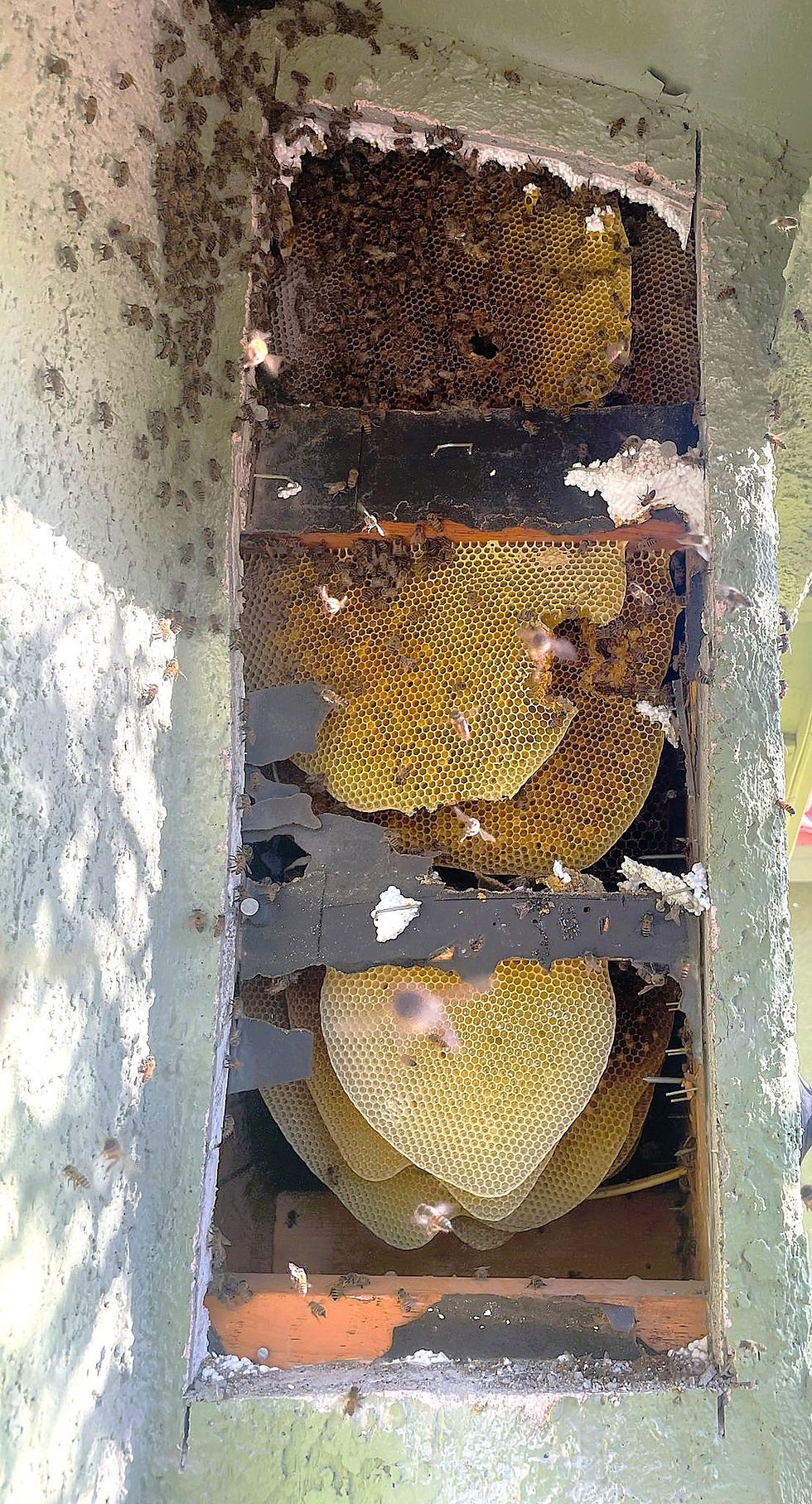
What Happens If You Use Sprayfoam to Seal a Beehive Inside a Wall?
When the main entrance gets blocked, returning forager bees don't just give up. They search aggressively for another way in. That search can lead them through light fixtures, ceiling vents, wall outlets, attic spaces, and interior drywall gaps.
We've responded to jobs in Las Vegas where a homeowner sealed an exterior crack in the morning and had bees appearing inside their bedroom and kitchen by evening.
Even if a portion of the colony does die off, the hive materials stay inside your wall.
In a Las Vegas summer, where temperatures routinely hit triple digits, that means honey, wax comb, pollen, and dead bees sitting in a hot enclosed space. That material melts, ferments, and soaks into your drywall and framing.
The odor is genuinely unpleasant, and the mess attracts ants, cockroaches, rodents, flies, and wax moths. A neglected hive can also permanently stain ceilings and walls as honey seeps through.
Old hive material also releases smells that attract new swarms for years. If you seal a hive in and the bees die, you may find a new colony moving into the same wall cavity the following spring.

Can Bees Have More Than One Entrance into Their Beehive?
Almost always, yes.
The hole you can see from the driveway is usually not the only access point. Bees in Las Vegas stucco homes frequently exploit weep holes, conduit gaps, cracks behind fascia boards, expansion joints, attic vents, and openings around pipes.
The visible entrance is often just the most trafficked one.
This is one of the most common misconceptions we encounter. A homeowner seals one crack, feels good about it, and then finds bees pouring out of a new location the next day. The colony didn't go anywhere. It just rerouted.
Can I Use Caulk, Steel Wool, or Tape Instead of Spray Foam?
No. The material doesn't change the underlying problem.
Whether you reach for spray foam, caulk, cement, steel wool, tape, or expanding sealants, sealing the entrance before the colony is removed will create the same set of issues. The bees are still inside. They're still alive, still motivated, and still capable of finding or creating a new exit.
The only thing that changes when you use a harder material is that the removal job becomes more complicated. Hardened foam and caulk can hide the original entry point and force a professional to work with less information about where the bees actually are and how extensive the colony has become.

I Only See a Few Bees Going In. Can It Really Be That Bad?
Yes, it can.
A mature honey bee colony can contain tens of thousands of bees. The number of bees you see coming and going from the entrance on a given afternoon represents only a fraction of the total population.
What looks minor from your front yard could be a fully established colony that's been building inside your stucco for months.
In Las Vegas specifically, the summer heat accelerates hive growth. Bees are also drawn to the cooler interior of wall voids as temperatures climb, which means infestations that start in spring can become substantial by the time you notice them in June or July.
Swarms most times move on within a few days, but an established colony will not leave on its own.
There's an important distinction here. A swarm is a group of bees temporarily clustered while scouts search for a new home. If you see a dense ball of bees hanging from a tree branch or your eave, that's a swarm, and it may relocate without any intervention within 24 to 72 hours.
But if bees are flying in and out of a crack in your wall, they've already found their home. They're building comb, raising brood, and storing honey.
That colony will not leave voluntarily, and it will grow. Waiting weeks or months typically means more comb, more honey, a larger population, and a more involved removal process.
Is It Dangerous to Have Bees in My Walls in Las Vegas?
It can be, for a couple of reasons specific to this area.
Africanized honey bees are well-established throughout Clark County and look identical to European honey bees.
They are significantly more defensive, respond faster when they feel threatened, and will pursue a perceived threat much further than a typical European colony would.

Any hive inside a Las Vegas structure should be treated as potentially Africanized until confirmed otherwise.
Beyond the sting risk, there's the structural concern. A mature hive can hold a substantial amount of honey. In a Las Vegas summer, that honey can liquify rapidly and soak through drywall, stucco, and framing.
We've seen hives cause real water-like damage to interior walls and ceilings, and the cleanup required after the fact is far more expensive than a professional removal would have been.
What Should I Do Instead of Sealing the Hole?
Leave the entrance alone and call a professional for an assessment.
A live bee removal specialist can determine whether you're dealing with a new swarm or an established colony, estimate how long the bees have been there, identify where the comb is likely located, and recommend the right approach for your specific situation.
The earlier you act, the better. A fresh swarm is a simple job. A colony that's been in your wall for six months, in a Las Vegas summer, is a much more involved extraction.
Early removal is almost always faster, less invasive, and less expensive.
If you're in Las Vegas and you suspect bees are living inside your stucco wall, block wall, roofline, or attic, the right first move is to get the situation properly assessed before anything gets sealed. Spray foam can wait. The bees, unfortunately, cannot.
Betsy & Pete
Vegas Bees provides live bee removal and relocation throughout Las Vegas, Henderson, Summerlin, North Las Vegas, and the greater Clark County area. We remove bees from stucco walls, block walls, roofs, attics, eaves, irrigation boxes, and more.
About Us: The Authors

We’re Betsy Lewis and Pete Rizzo - Beekeepers on a Mission in Las Vegas
We’re not just in the bee business, we’re in the bee-saving business. Trained by a master beekeeper and backed by hundreds of successful removals, we are dedicated to rescuing and relocating honey bees with care and precision.
Every swarm we save and every hive we manage reflects our deep love for the bees.
At our Joshua Tree Preserve in Arizona, we care for dozens of thriving hives. Some wild, some honey-bearing, and all are part of our commitment to ethical, sustainable beekeeping.
Why Vegas Bees? Because We Never Stop Learning or Caring
Beekeeping is always evolving, and so are we. We stay on the cutting edge by continuing our education, connecting with fellow beekeepers, and refining our beekeeping practices and techniques to ensure the best outcomes for both bees and people.
Whether it’s advanced bee removal strategies or the latest natural methods, we’re always one step ahead.
We’re also proud to support the beekeeping community with high-quality beekeeping supplies for everyone. If you’re ready to suit up and start your journey, we’ve got what you need. Wanna become a beekeeper? Read our Beekeeping for Beginners Guide.


